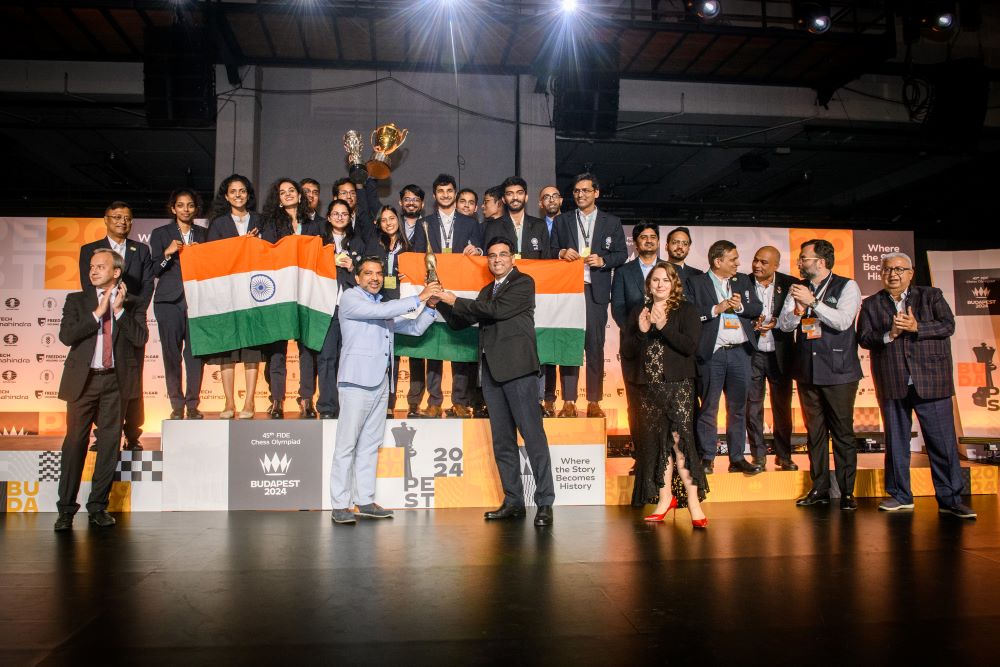
The 45th Chess Olympiad, held on Sunday, September 22, 2024, in Budapest, will forever be etched in the annals of Indian chess history. In a magnificent display of talent, precision, and indomitable spirit, the Indian chess contingent stunned the world by achieving what was once considered a distant dream. The team bagged an impressive haul of four individual gold medals, two team golds, and the highly coveted Nona Gaprindashvili Cup for the second consecutive time. This victory not only underscored India’s emerging dominance on the global chess stage but also signified the rise of a new generation of Indian chess prodigies, poised to take the game to unprecedented heights.
Indian chess has long been influenced by the towering legacy of the legendary Grandmaster (GM) Viswanathan Anand, a five-time world champion whose brilliance inspired an entire generation to take up the sport. Today, a fresh wave of talent, including GM D Gukesh, GM Praggnanandhaa R, GM Arjun Erigaisi, GM Vidit Gujrathi, and GM Pentala Harikrishna, is carrying forward this torch, exceeding expectations and writing a new chapter in Indian chess. Under the leadership of team captain GM Srinath Narayanan, these young stars have set the global chess arena alight with their innovation, determination, and unwavering hunger for victory. Their collective performance has left a lasting mark on this Olympiad and cemented India’s place as a true chess powerhouse.

From the very outset, the Indian men’s team exhibited commanding form, winning 10 matches and drawing only one. By the time they reached the final round, they were two points clear of traditional powerhouse China, needing only a draw to clinch the gold. However, in typical Indian fashion, the team went above and beyond, defeating Slovenia 3.5-0.5 in a commanding final performance. Leading this charge was GM Gukesh, who scored an extraordinary 9 points from 10 games, earning him the individual gold on Board 1. Not far behind, GM Arjun Erigaisi secured the individual gold on Board 3 with a stunning score of 10 points from 11 games. With both players approaching elite status and Erigaisi nearing the prestigious 2800 rating mark, their contributions solidified India’s dominance on the global chess circuit.
Equally impressive was the Indian women’s team, led by captain IM Harika Dronavalli. Comprising IM Vaishali R, IM Divya Deshmukh, IM Vantika Agrawal, and WGM Tania Sachdev, the team began the tournament with seven consecutive victories. Despite a setback in round eight, where they lost to Poland and drew against the USA, the women quickly regrouped. They capped off the tournament with a resounding 3.5-0.5 victory over Azerbaijan in the final round. Kazakhstan’s draw with the USA secured India the top spot in the women’s section. IM Divya Deshmukh emerged as the standout player with an individual gold on Board 3, while IM Vantika Agrawal clinched another individual gold on Board 4, further highlighting the strength of Indian women in chess.
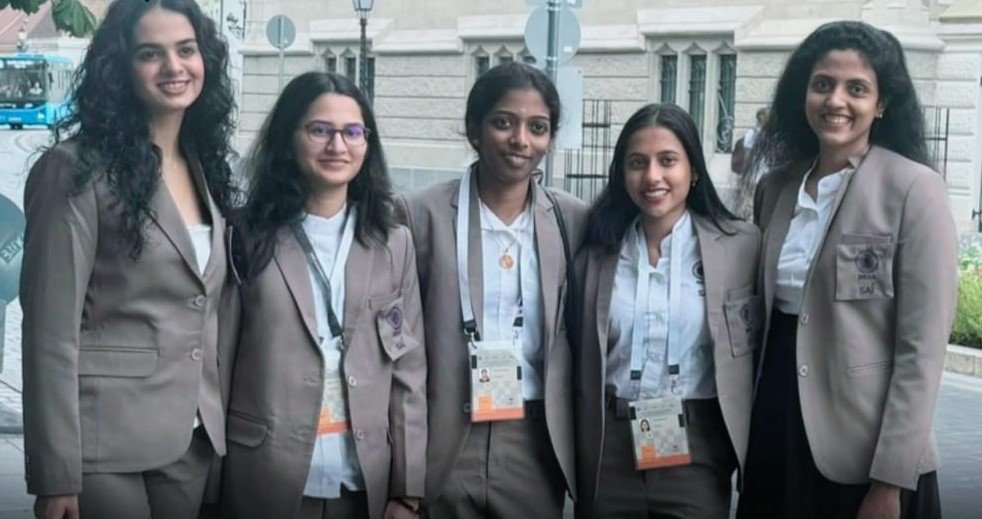
In the open section, India finished with 21/22 points, a four-point margin over both the USA and Uzbekistan, marking the largest point gap in recent Olympiad history. This achievement underscored the men’s team’s unprecedented level of performance, one that other top chess nations struggled to match. On the women’s side, India topped the standings with 19/22 points, narrowly edging out Kazakhstan by a single point, while the USA settled for third place. Both Indian teams struck a perfect balance between youthful exuberance and seasoned experience, blending the innovation of rising stars with the wisdom of veterans. The result was a performance that left traditional chess powerhouses scrambling.
The Olympiad was made even more special by the presence of chess legends such as GM Viswanathan Anand, GM Judit Polgar, GM Dibyendu Barua, and GM Abhijit Kunte. For Anand, in particular, the moment was one of immense pride. The players he once mentored were now taking Indian chess to even greater heights, continuing the “Golden Era” that Anand had ushered in. Witnessing this historic achievement first-hand, the stalwarts of Indian chess rejoiced in the success of the new generation, marking the continuation of India’s meteoric rise in the global chess scene.

What makes India’s triumph even more remarkable is the sheer magnitude of its dominance. Winning gold in both the open and women’s sections, along with a clean sweep of individual gold medals, is an achievement that had never been accomplished in such fashion before. India’s commanding points tally, coupled with consistent brilliance across all boards, has heralded the arrival of a new superpower in the world of chess. The global chess community has taken notice: India is no longer just a rising star but an established force in the game, with many more victories yet to come.
India’s dominance at the 45th Chess Olympiad was not a mere stroke of luck but the result of years of dedicated preparation, intense training camps, and strategic foresight. Team captain GM Srinath Narayanan played a pivotal role in creating an environment of unity and mutual support, fostering a cohesive team dynamic that allowed both the men’s and women’s teams to excel. The young stars—GM Gukesh, GM Praggnanandhaa, and IM Divya Deshmukh—stood out not just for their talent but for their unshakable resolve and tactical brilliance. Gukesh’s aggressive style left many of his opponents scrambling, while Praggnanandhaa’s fearless approach further enhanced his reputation as a chess prodigy.
The women’s team, too, shone brightly. IM Divya Deshmukh’s gold-winning performance on Board 3 was a standout moment, showing her potential as a future star of Indian chess. Her contributions, along with those of IM Vantika Agrawal and others, were instrumental in the team’s triumph. Together, the achievements of these players underscored that Indian chess is no longer reliant on just a handful of exceptional talents. Instead, the country has fostered a system—a deeply ingrained culture of chess nurtured through grassroots initiatives, governmental support, and the rise of chess academies.
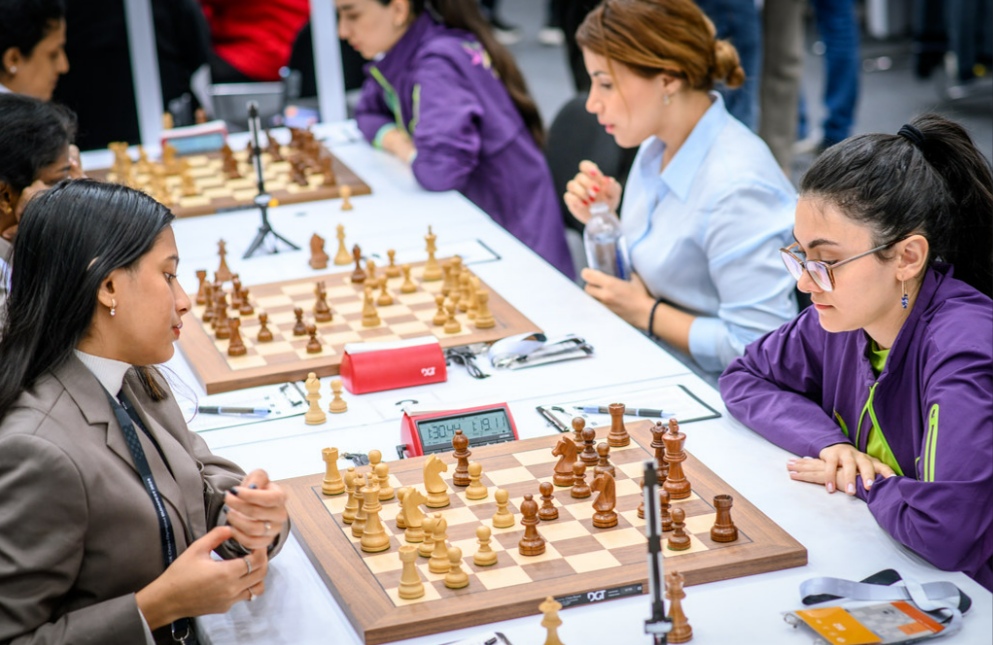
As the dust settled on this historic Olympiad, the mood within the Indian camp was not one of surprise but of satisfaction. This was a victory that had been meticulously planned for, and it was delivered through sheer dedication and unyielding determination. The impact of this triumph will undoubtedly inspire a new generation of chess players across India, encouraging them to take up the game and aim for global success.
The future of Indian chess shines brightly, with stars like Gukesh, Praggnanandhaa, and Divya Deshmukh leading the charge. India is well-positioned to continue its reign as a chess superpower, and the possibilities ahead seem limitless. The nation stands united in celebrating its chess heroes, knowing that this is just the beginning of an era of sustained brilliance on the global chessboard.

India’s historic performance at the 45th Chess Olympiad is not just a victory but a powerful testament to the nation’s commitment to excellence in chess. With a blend of young talent and seasoned leadership, the Indian chess juggernaut has firmly established its place on the world stage. As India’s “golden generation” embraces its newfound status, the country’s future in chess appears brighter than ever, and the global chess community waits in anticipation for more extraordinary achievements from this emerging chess superpower.
VISIT ARJASRIKANTH.IN FOR MORE INSIGHTS
 SOCIAL PERSPECTIVES