
Laddugate: Divine Blessings Become Political Poison!
In recent times, the state of Andhra Pradesh has been engulfed in a controversy of unprecedented proportions, centering around a most unexpected source: the laddu prasadam offered at the Tirumala Tirupati Devasthanam (TTD). What is typically a sacred offering revered by millions of devotees across the globe has suddenly found itself entangled in a web of political allegations, accusations of corruption, and claims of religious desecration. The laddu, long viewed as a symbol of divine blessing, has become the focal point of a dramatic and bitter political battle, raising questions about faith, governance, and trust.
The laddu prasadam is no ordinary sweet. It is not merely a confection but a sacred offering distributed to devotees visiting the world-famous Venkateswara temple in Tirumala. For many Hindus, receiving this laddu is akin to receiving the blessings of Lord Venkateswara himself. Its preparation and distribution are steeped in religious ritual, making it one of the most cherished and symbolic prasadams in Hinduism. Yet, it is precisely this sacredness that has been called into question, transforming the laddu from a divine blessing into a political flashpoint.
At the centre of this storm lies an allegation that shook the faith of millions: the claim that the ghee used in preparing the laddus had been adulterated with animal fats, including beef tallow. These allegations sent shockwaves through both the religious and political spheres, igniting a firestorm of debate, public outrage, and media scrutiny. The controversy became even more charged given the religious sensitivities involved. For many Hindus, the mere suggestion of such an adulteration in the sacred offering is an affront to their deeply held beliefs.
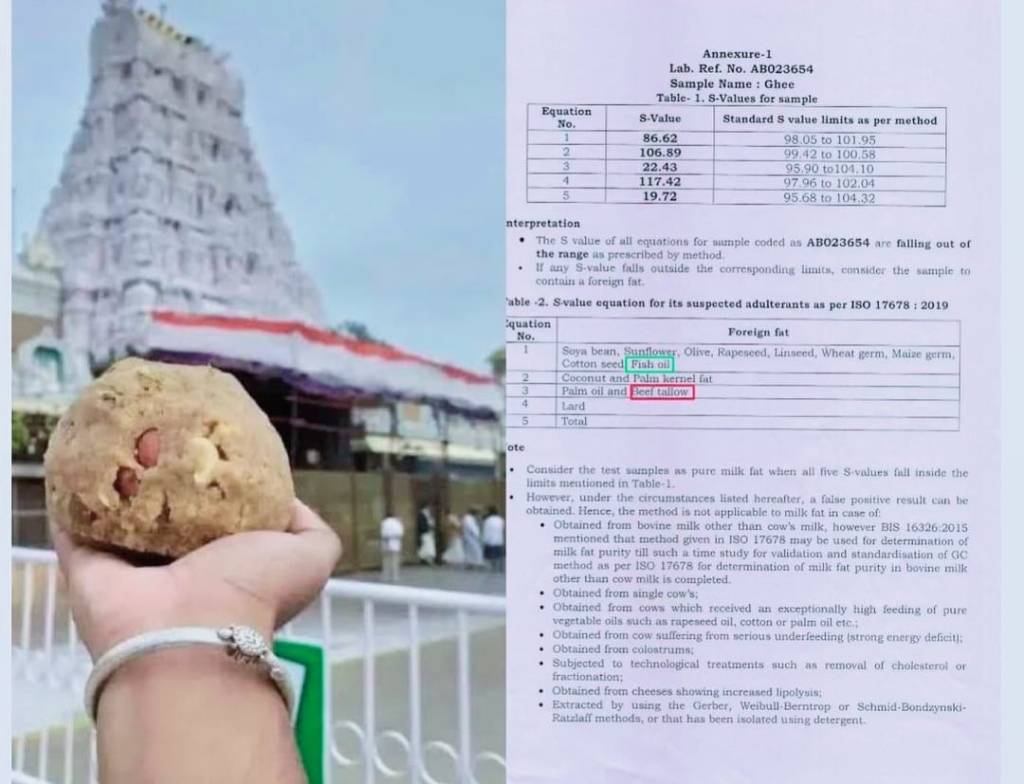
The situation became particularly explosive due to the timing and the key players involved, as the accusations of adulteration quickly took on a political dimension. The present government blamed the previous administration for mismanagement and negligence, alleging that the purity of the laddu, and by extension the sanctity of the temple, had been compromised under their watch. These allegations extended to the procurement process of ingredients, especially the switch in ghee suppliers from Nandini to Aavis, with claims that this change facilitated corruption and compromised quality control.
The change in the supplier of ghee from the once-reliable Nandini brand to a different cooperative, (Aavis) a move that occurred during the previous administration, has been cited as the root cause of the alleged adulteration. Nandi, based in Karnataka, had supplied ghee to the TTD for years and was known for its quality. However, a shift to a new supplier, driven by decisions made by the temple administration, raised concerns about whether the same rigorous standards were being maintained. Critics of the government argue that the switch was not made in the best interest of the temple but was instead a politically motivated decision.
These concerns took a dramatic turn when lab reports allegedly surfaced, suggesting that the ghee used in the laddus was contaminated with not only vegetable oils but also animal fats such as beef tallow and lard. The accusations, if proven true, would have far-reaching consequences, not just for the temple administration but for the ruling government itself. Such contamination would be viewed as a desecration of one of the holiest offerings in Hinduism and could deeply offend the sentiments of millions of devotees worldwide.
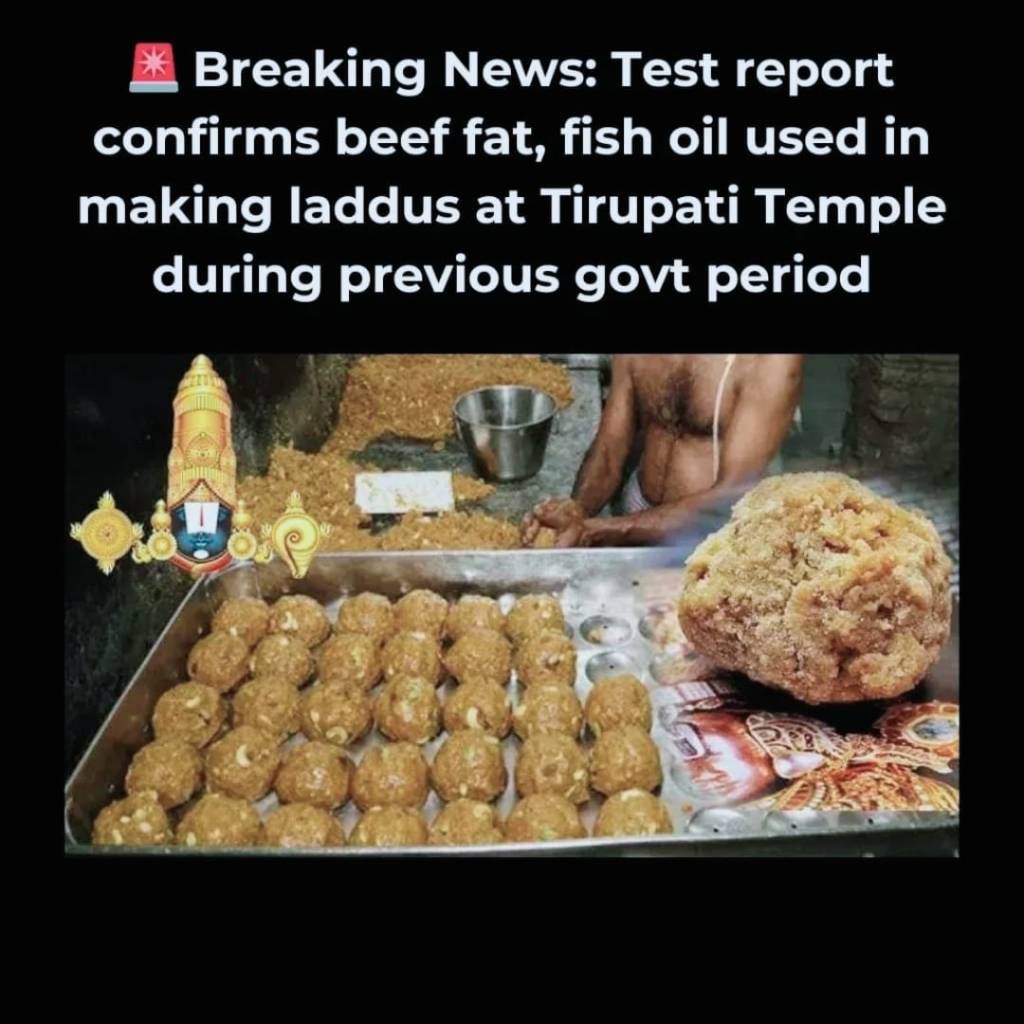
Political parties swiftly seized the opportunity to weaponize the issue, accusing one another of gross negligence, corruption, and a failure to protect the sanctity of the temple. Leaders publicly demanded investigations and immediate action to restore devotees’ faith. As the scandal escalated, the opposition framed the matter not just as a religious or administrative failure but as a moral betrayal of the people’s trust, asserting that both past and present governments had compromised the integrity of one of Hinduism’s most sacred institutions.
In response, the former ruling party strongly denied the allegations, accusing their political opponents of fabricating the controversy for electoral gain. They dismissed the lab reports as unsubstantiated and emphasized that the temple’s ghee procurement processes adhered to strict guidelines. Party leaders asserted that the ghee used in the laddus met all quality standards and was free from any contamination. To counter the opposition’s narrative, they portrayed the controversy as a baseless attack intended to incite religious tensions for political advantage.
Caught in the midst of this political storm is the Tirumala Tirupati Devasthanam (TTD). The temple administration, entrusted with the sacred duty of preparing the laddu prasadam, found itself grappling with an unprecedented crisis of trust. As accusations escalated and tensions ran high, the TTD faced the monumental challenge of assuring millions of devotees that their revered offering remained pure and untarnished. Renowned as one of India’s most efficiently managed religious institutions, the TTD’s credibility was at stake. The controversy was further fuelled by critics pointing to the former Chief Minister’s non-Hindu background and allegations of nepotism surrounding an unauthorized and reportedly incompetent Executive Officer, who despite numerous controversies, continued to enjoy undue favouritism. This scandal posed a serious threat to the institution’s longstanding reputation.
The TTD leadership has responded to the crisis by promising to conduct a thorough investigation into the allegations. They have pledged to be transparent in their findings and to take corrective measures if any lapses in quality control are discovered. However, even as the temple administration strives to contain the fallout, the damage to public trust has already been significant. Devotees, who have long regarded the laddu as a divine blessing, are now questioning whether their faith has been exploited for political or financial gain.
As the controversy continues to simmer, religious organizations have also weighed in, demanding answers from both the government and the temple administration. Groups representing Hindu interests have called for swift action to restore the sanctity of the laddu prasadam and to hold accountable those responsible for any potential adulteration. They argue that the issue transcends politics, as it strikes at the very core of the spiritual beliefs of millions of Hindus. For these groups, safeguarding the purity of the laddu is a matter of protecting the faith of the community.

While the political fallout from the scandal is significant, the controversy has also sparked broader conversations about the role of politics in religious institutions. Critics argue that the intersection of politics and religion has led to the commercialization and corruption of sacred spaces. They point to the TTD laddu controversy as a prime example of how political interests can compromise the spiritual integrity of religious offerings. This debate has raised important questions about the need for greater transparency and accountability in the management of religious institutions, particularly those that receive large amounts of public donations.
The political battle over the laddu prasadam is far from settled. As both sides persist in exchanging heated rhetoric, this controversy has the potential to significantly influence the political landscape of Andhra Pradesh in the coming months. The public is likely to continue advocating for an independent investigation, while the ruling government is eager to conduct a thorough inquiry. However, the true challenge for both factions lies in addressing the deeper issues of faith and trust that this scandal has exposed. The outcome will depend not only on the investigations but also on how effectively both sides can restore confidence among devotees and the wider community.
The laddu controversy has touched a nerve in Andhra Pradesh, not just because of its political implications but because of the deep spiritual significance of the offering. For many devotees, the laddu prasadam is more than just a sweet—it is a tangible connection to the divine. The allegations of adulteration have shaken that connection, leaving many to wonder whether their sacred offering has been compromised by human greed and political machinations. As the political firestorm continues to rage, the challenge for all involved will be to find a way to restore that lost trust.

In the end, the controversy over the TTD laddu prasadam is not just a political scandal—it is a test of faith for millions of devotees. It is a reminder that religious institutions, no matter how revered, are not immune from the forces of politics and corruption. As the battle over the laddu continues to unfold, the sacred offering remains at the centre of a broader conversation about governance, accountability, and the role of faith in public life. Whether the laddu can emerge from this scandal unscathed remains to be seen, but one thing is clear: the political firestorm that has erupted over Tirupati’s most cherished offering is far from over.
VISIT ARJASRIKANTH.IN FOR MORE INSIGHT
 SOCIAL PERSPECTIVES