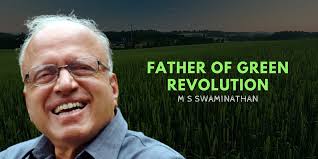
Celebrating the Legacy of M.S. Swaminathan on His Birth Anniversary
On 7 August 1925, a visionary was born in India whose contributions would transform the landscape of Indian agriculture and ensure food security for millions. Mankombu Sambasivan Swaminathan, widely known as the “Father of the Green Revolution in India,” played a pivotal role in developing and introducing high-yield varieties of wheat and rice, marking a significant turning point in India’s agricultural history.
Swaminathan’s journey in the realm of agriculture began with a strong academic foundation. He studied at the University of Madras and the Indian Agricultural Research Institute (IARI), where his fascination with genetics and plant breeding took root. His profound understanding of these fields would later fuel his ground breaking work in enhancing crop productivity in India.
The mid-20th century presented a grim scenario for India, as the nation grappled with severe food shortages and a rapidly growing population. In this context, Swaminathan’s efforts emerged as a beacon of hope. He collaborated with Nobel Laureate Norman Borlaug, whose development of high-yielding dwarf wheat varieties laid the groundwork for the Green Revolution. Swaminathan’s adaptation and extensive promotion of these varieties in India revolutionized the country’s agricultural practices.
Swaminathan’s role was not just limited to the introduction of high-yielding varieties. His comprehensive approach encompassed improving irrigation facilities, advocating the use of fertilizers and pesticides, and enhancing agricultural extension services to ensure that farmers could adopt these new technologies effectively. His holistic vision aimed at transforming Indian agriculture from a subsistence-based system to a more productive and resilient one.
In 1961, the establishment of the Mexican wheat program in India marked the beginning of the Green Revolution. Swaminathan’s relentless efforts led to the widespread adoption of high-yielding varieties of wheat, which resulted in a dramatic increase in food grain production. By the mid-1970s, India had achieved self-sufficiency in food grains, a monumental achievement considering the country’s dire circumstances just a decade earlier.
Swaminathan’s impact extended beyond wheat. Recognizing the need for diversifying India’s food basket, he also promoted the adoption of high-yielding varieties of rice. His work with the International Rice Research Institute (IRRI) further bolstered his efforts. As Director General of IRRI from 1982 to 1988, Swaminathan was instrumental in advancing rice research and improving rice cultivation techniques globally.
Throughout his illustrious career, Swaminathan’s contributions were not confined to research and development. He served as the Director General of the Indian Council of Agricultural Research (ICAR) from 1972 to 1979, where he implemented numerous policies and programs aimed at strengthening India’s agricultural research infrastructure. His tenure as Principal Secretary of the Ministry of Agriculture from 1979 to 1980 further showcased his administrative acumen and commitment to agricultural development.
One of Swaminathan’s most significant legacies is the establishment of the MS Swaminathan Research Foundation (MSSRF) in 1988. The foundation’s mission, inspired by Swaminathan’s vision, is to eradicate hunger and poverty by promoting sustainable and equitable agriculture. MSSRF has been at the forefront of advocating environmentally sustainable agricultural practices, aiming to achieve what Swaminathan terms an “evergreen revolution.”
Swaminathan’s concept of an evergreen revolution emphasizes the need for sustainable food security by balancing productivity with environmental conservation. He has consistently championed the preservation of biodiversity and the adoption of agro-ecological approaches to farming. His vision underscores the importance of ensuring that agricultural development does not come at the cost of environmental degradation, thereby securing the well-being of future generations.
In recognition of his monumental contributions, Swaminathan has received numerous accolades and honors. In 1999, Time magazine included him in its list of the 20 most influential Asian people of the 20th century. His global influence is further underscored by his presidency of the International Union for Conservation of Nature and Natural Resources in 1988.
Swaminathan’s legacy is not just confined to his scientific achievements. His unwavering commitment to social equity and justice has been a defining feature of his career. He has tirelessly advocated for policies that support small and marginal farmers, emphasizing the need to create an inclusive and equitable agricultural system. His work has inspired countless individuals and institutions to pursue a path of sustainable development, ensuring that the benefits of agricultural progress reach the most marginalized sections of society.
As we celebrate the birth anniversary of M.S. Swaminathan, it is essential to reflect on the enduring impact of his work. His vision and dedication have not only transformed Indian agriculture but have also provided a blueprint for sustainable development worldwide. Swaminathan’s contributions remind us of the power of scientific innovation and compassionate leadership in addressing some of the most pressing challenges of our time.
In conclusion, the legacy of M.S. Swaminathan stands as a testament to the profound impact that one visionary can have on a nation’s future. His contributions to Indian agriculture have not only alleviated hunger and poverty but have also laid the groundwork for sustainable agricultural practices that continue to benefit millions. Swaminathan’s holistic approach, combining scientific innovation with a deep commitment to social equity, has transformed India’s agricultural landscape and inspired global efforts towards sustainable development. As we commemorate his birth anniversary, we honor not just the “Father of the Green Revolution in India” but a relentless advocate for an inclusive and resilient agricultural system. Swaminathan’s life work exemplifies the power of dedication and vision in creating lasting change, reminding us that the path to progress lies in balancing human needs with the preservation of our environment. His enduring influence will continue to guide and inspire future generations in their quest for a world free from hunger and poverty, embodying the very essence of an evergreen revolution.
visit arjasrikanth.in for more insights
 SOCIAL PERSPECTIVES