The race for technological supremacy between the United States and China reshapes global dynamics.
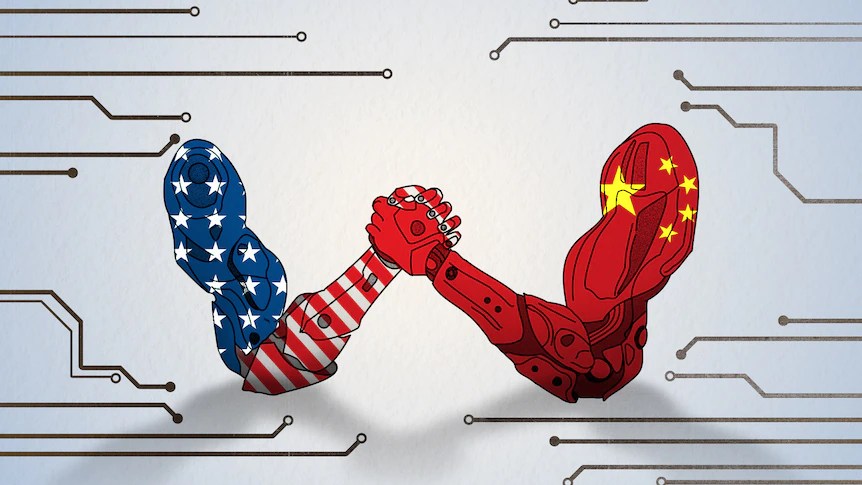
In the relentless pursuit of technological dominance, the United States and China emerge as principal contenders, engaging in a fierce competition across various sectors like green technology and semiconductors. This rivalry, often termed the “tech war,” transcends mere economic competition, encompassing issues of intellectual property theft, cyber espionage, and restrictions on technology transfer. It mirrors broader geopolitical tensions, reflecting the struggle for dominance between these two superpowers on the world stage. While some analysts predict continued US hegemony, others foresee China’s ascendancy challenging the established international order, raising concerns of a potential Thucydides Trap scenario.
This multifaceted relationship defies simplistic categorization, as evidenced by the complexities of the tech war. While US policymakers broadly agree on the need to confront China, there’s divergence in strategies, ranging from engagement to containment. The US prioritizes maintaining technological primacy amid fears of China’s military advancements, employing geo=economic tools to curb its influence. However, the efficacy of such measures remains uncertain, given the interconnectedness of the global economy. Despite efforts towards decoupling, particularly in high-tech sectors, Chinese resilience poses challenges to US objectives. Ultimately, the US appears willing to recalibrate its traditional role to safeguard national interests and sustain its global primacy amidst the rise of China.

The conflict between the United States and China, catalyzed during Donald Trump’s presidency, revolved around concerns regarding China’s burgeoning influence. Trump enacted measures to restrict the export of advanced technology to China and limit its utilization of artificial intelligence. However, President Biden’s approach has been more conciliatory, advocating for cooperation while safeguarding American interests.
The tech war between the two nations has evolved from a mere trade dispute into a fierce competition for supremacy in critical sectors such as 5G, artificial intelligence, and semiconductors. While the US has traditionally led in technological innovation, China’s aggressive initiatives, backed by significant state funding, aim to narrow the gap. Tensions heightened as Washington imposed restrictions on China’s access to crucial US-controlled technologies, prompting Beijing to pursue self-sufficiency and reduce dependence on American suppliers.

The COVID-19 pandemic exacerbated these tensions, prompting President Biden to order a review of essential supply chains. Bipartisan support for bills increasing investment in core technologies underscores US apprehensions regarding China’s Made in China 2025 initiative, which seeks to elevate the country’s status to a global manufacturing powerhouse. The tech war gained momentum through various events, including sanctions on Chinese firms and concerns over intellectual property theft and Huawei’s dominance in 5G technology.
Decoupling, once deemed unrealistic, gained traction as calls mounted to lessen reliance on Chinese supply chains. President Biden’s executive order signaled a shift towards reassessing critical product supply chains. In response, China emphasized tech self-sufficiency, intensifying efforts to attain semiconductor independence despite skepticism from analysts regarding its feasibility.

The battle for technological supremacy encompasses critical industries such as green energy and semiconductors, where China has made substantial progress, particularly in solar panel production, battery manufacturing, and electric vehicles. In contrast, the United States has been bolstering its chip market through subsidies and enticing leading chip companies to establish advanced factories domestically. This competition is not only reshaping global supply chains but also influencing the affordability and accessibility of these advanced technologies.
The conclusion of the post-Cold War era has ushered in a new phase of geopolitical competition, notably between the United States and China. This rivalry, reminiscent of the Cold War, encompasses nuclear tensions, ideological differences, and proxy conflicts. A significant dimension of this contemporary struggle is the race for technological dominance, particularly in sectors like 5G, artificial intelligence (AI), and semiconductors.

Dubbed a “tech war” by the media, this competition highlights the pivotal role of technology in shaping global markets, military capabilities, and regulatory frameworks. The US, perceiving challenges to its technological leadership, has intensified efforts to strengthen its high-tech industries and counter China’s technological advancements. This entails substantial investments in domestic research and development (R&D) and measures aimed at restricting China’s access to advanced technologies.
However, framing this competition as a “war” raises concerns about the potential militarization of economic and scientific rivalries, which could foster nationalism and discrimination. Nevertheless, the urgency of maintaining technological leadership, particularly in the face of China’s ambitious initiatives like Made in China 2025 and the Belt and Road Initiative, necessitates significant action. Despite debates over the appropriateness of the war metaphor, the stakes are high, with far-reaching implications for global power dynamics and the future trajectory of emerging technologies.

Both China and the United States have leaned on subsidies as a key strategy to drive their technological advancements. China’s subsidization efforts, spanning over a decade, have propelled its success in green technology, particularly in sectors like semiconductors. Conversely, the US has offered significant subsidies to entice chip manufacturers to establish operations within its borders. While this subsidy-driven approach has intensified the technological competition, it has also sparked concerns regarding subsidy misuse and its potential impact on global economic dynamics.
The US CHIPS Act, for instance, proposes substantial subsidies exceeding USD 52 billion, coupled with a 25% tax credit, specifically aimed at bolstering the domestic semiconductor industry. In contrast, Chinese companies like BYD Co. have benefited from substantial government subsidies, totaling at least €3.4 billion ($3.7 billion), as part of Beijing’s endeavor to dominate the electric vehicle and clean technology sectors.

China’s advantages in tech-intensive industries stem from factors such as its larger population, lower wages, and robust government support for manufacturers. Production costs for chips in the United States remain significantly higher and more time-consuming compared to Asian counterparts, underscoring China’s competitive edge in this arena. The trajectory of the conflict between the United States and China will be heavily influenced by the approach of the next American administration, whether under Donald Trump or Joe Biden. Trump’s administration adopted an aggressive stance, aiming to impede technology flow into China, while Biden’s administration has pursued a more diplomatic approach, collaborating with allies to address the issue collectively. These differing strategies will impact trade, investment, and the pace of the energy transition.

Two significant dates from 2022 mark pivotal moments in geopolitical history. The first is Russia’s invasion of Ukraine on February 24, while the second, on October 7, saw the United States implement export controls aimed at stifling China’s progress in AI technology. These controls targeted China’s access to crucial computer chip hardware, essential for AI advancement. Subsequently, Japan and the Netherlands also imposed strict export controls on semiconductor manufacturing equipment, further restricting China’s access to essential technology.
The ongoing tech wars between the US and China are reshaping global relationships and supply chains, with substantial economic costs estimated at about 1.2% of global GDP annually. As the conflict intensifies, both American and Chinese leadership remain resolute, making it a central issue with strong bipartisan support in Washington and underscoring its significance as an “ethno-civilizational question” concerning control over energy and information technologies.

The technology war between America and China has far-reaching implications for global economic growth, energy transition, and the balance of technological power. As both nations aggressively pursue control over advanced technologies, industries like green tech and semiconductors become battlegrounds for supremacy. The strategies employed, including subsidies and export controls, have the potential to shape the future of these industries and impact the pace of global decarbonization. It remains to be seen how the conflict will unfold under the next American government, but one thing is clear: the battle for technological dominance will continue, with significant consequences for the future of the planet.
VISIT ARJASRIKANTH.IN FOR MORE INSIGHTS
 SOCIAL PERSPECTIVES