Unlocking the Secrets of the Sun: Exploring the Significance of Total Solar Eclipses

A total solar eclipse, a rare and captivating phenomenon, occurs when the moon aligns perfectly between the sun and a specific point on Earth, momentarily obscuring the sun’s light. This extraordinary event presents scientists and astronomers with an unparalleled opportunity to study various facets of our solar system, from the behaviour of the sun and the moon to the effects on Earth’s atmosphere. In this comprehensive exploration, we delve into the scientific importance of solar eclipses, the phenomena they enable scientists to investigate, and their broader implications for understanding our universe.
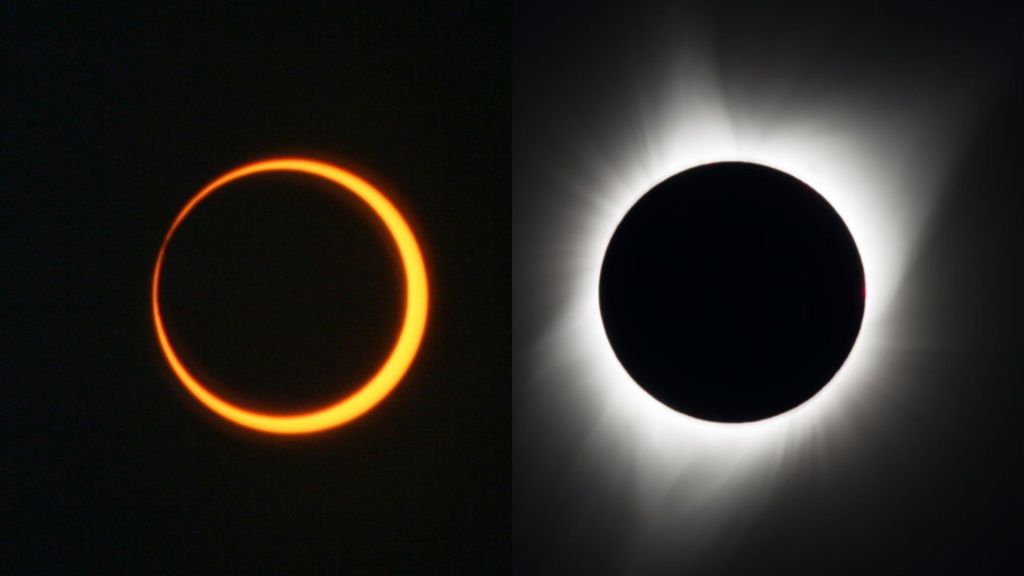
Solar eclipses result from the precise alignment of the Sun, Moon, and Earth, despite their vast distances from each other. The Sun, situated approximately 1500 lakh km away, dwarfs the moon, which is relatively closer at a distance of 3.8 lakh km from Earth. These alignments give rise to two to five solar eclipses annually, averaging around 240 per century, with a maximum of five occurring in a single year. Total solar eclipses, a rare spectacle, grace Earth’s skies once every 360 years in a specific location, occurring globally every one to three years. However, their visibility is often limited to regions near the poles or over the vast expanse of the oceans. Despite their infrequency, over a 5,000-year period spanning from 2000 BCE to 3000 CE, Earth is expected to witness a staggering total of 11,898 solar eclipses, comprising various types, including partial, annular, total, and hybrid eclipses.

Solar eclipses occur due to the alignment of the Sun, Moon, and Earth, where the Moon blocks the Sun’s light as observed from Earth. This alignment allows for the rare occurrence of a total solar eclipse, during which the Sun’s entire disk is obscured by the Moon, revealing its corona, or outer atmosphere.
For scientists, solar eclipses provide a unique opportunity to advance understanding of the Sun and its effects on Earth and the solar system. By studying the behaviour of the Sun’s corona, scientists can gain insights into solar dynamics, such as solar flares and coronal mass ejections, which can impact space weather and Earth’s magnetosphere.
During a total solar eclipse, astronomers can observe the Moon’s surface in detail, providing valuable data on its composition, geological features, rotation, and tilt. Additionally, the sudden drop in sunlight during an eclipse triggers changes in atmospheric conditions, allowing scientists to study temperature, air pressure, and ionospheric anomalies.

Solar eclipses have played a pivotal role in scientific history, including the validation of Albert Einstein’s theory of general relativity. During a solar eclipse in 1919, astronomers observed the bending of starlight by the Sun’s gravitational field, confirming Einstein’s predictions and catapulting him to global fame.
Beyond their scientific significance, solar eclipses evoke a sense of awe and wonder in observers, fostering humility and inspiring contemplation of our place in the universe. Studying the psychological effects of eclipses can provide insights into human perception and consciousness.
As technology advances, scientists continue to refine their understanding of solar eclipses and their broader implications. Future research may focus on leveraging eclipses as natural laboratories for studying solar phenomena and their effects on Earth’s atmosphere and space weather.
Solar eclipses are not just remarkable celestial phenomena; they offer scientists and astronomers an extraordinary opportunity to delve into the complexities of the Sun, Moon, and Earth system. Beyond their ability to captivate human curiosity, these events serve as invaluable gateways to unlocking the mysteries of our universe. By studying solar dynamics and other celestial phenomena during eclipses, researchers strive to expand the boundaries of scientific knowledge, paving the way for ground breaking discoveries. Looking forward, continued research and exploration of solar eclipses hold the promise of revealing fresh insights and nurturing a profound appreciation for the awe-inspiring wonders of the cosmos.
visit arjasrikanth.in for more insights
 SOCIAL PERSPECTIVES