Breaking the shackles of immunity, the Supreme Court’s recent ruling challenges the notion that politicians are above the law, setting the stage for a cleaner, more accountable political arena.
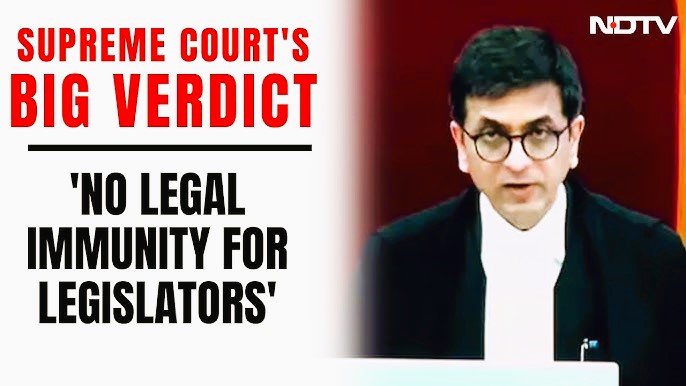
In a ground breaking move, the Supreme Court’s recent ruling shatters the myth of political immunity, ushering in an era where politicians are held accountable under the law. This landmark decision not only challenges the long-standing belief that politicians are beyond legal scrutiny but also paves the way for a more transparent and accountable political landscape.
The case, presented before a seven-judge bench, scrutinized the ramifications of the P.V. Narasimha Rao judgment on the relentless battle against corruption and the criminalization of politics. Solicitor General SG Mehta argued that the precedent inadvertently shielded individuals accepting bribes, in direct contradiction to the Prevention of Corruption Act, 1988 (PCA). On the opposing side, Senior Advocate Vijay Hansaria contended that the Narasimha Rao judgment allowed tainted individuals to persist in politics, posing a threat to India’s democratic fabric.
The bench, led by justices Bopanna, Sundresh, Narasimha, Pardiwala, Sanjay Kumar, and Manoj Misra, engaged in a meticulous examination of the implications of the Narasimha Rao judgment. They acknowledged the unintended protection granted to those involved in corruption, provided they avoided conviction and a two-year prison term. This interpretation was deemed incompatible with the spirit and objectives of the PCA, which aims to eradicate corruption at its roots.
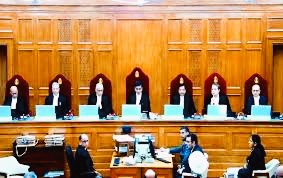
Following thorough deliberation, the Supreme Court declared the imperative to reassess the Narasimha Rao judgment in light of contemporary challenges posed by widespread corruption and the criminalization of politics. The focal point of the decision lies in the automatic disqualification of politicians facing serious criminal charges, even without a conviction. Chief Justice Chandrachud clarified that disqualification would occur when charges were framed by a court of law, preventing accused individuals from exploiting their positions to obstruct the judicial process.
While the verdict aimed to instill accountability, concerns were voiced about potential misuse for political vendettas. Critics argued that false implications could unfairly disqualify politicians. In response, the Supreme Court emphasized the importance of a fair and expeditious trial process. The recommendation to establish special courts dedicated to swiftly trying cases involving politicians aims to prevent unwarranted delays and address concerns of misuse.
The Supreme Court’s judgment is poised to reshape India’s political landscape, conveying a resounding message that politicians are not above the law and must face consequences for their actions. The automatic disqualification provision, coupled with an emphasis on expeditious trials, seeks to strike a delicate balance between accountability and preventing potential misuse. This decision is anticipated to elevate the moral standards of politicians and act as a deterrent for those with criminal backgrounds contemplating entry into politics.

In conclusion, the Supreme Court’s recent verdict represents a monumental shift in India’s political landscape. By challenging entrenched precedents and redefining the accountability of politicians, the court has taken a decisive step towards a cleaner and more transparent democratic system. The decision underscores a commitment to upholding the principles of justice, fairness, and the rule of law. As India progresses, this landmark judgment will undoubtedly have far-reaching implications, influencing the conduct of politicians and instilling confidence in the democratic process.
visit arjasrikanth.in for more insights
 SOCIAL PERSPECTIVES