India unveils the pioneers of India’s maiden manned space mission at Vikram Sarabhai Space Centre.
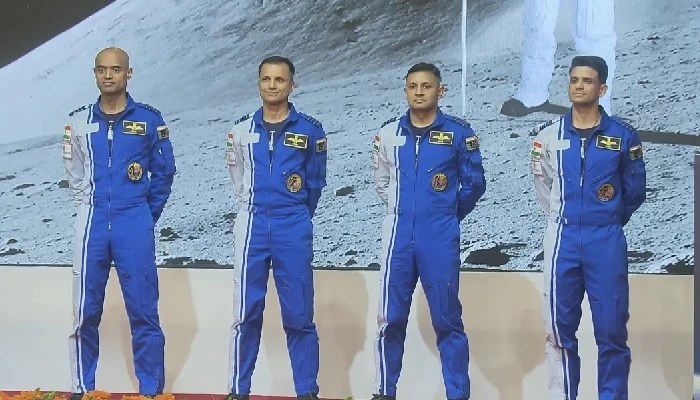
In a historic announcement on February 27, 2024, India, unveiled the names of the four astronauts selected to lead India’s maiden manned space mission, Gaganyaan. This momentous occasion marks a significant milestone in India’s space exploration journey, signifying the nation’s entry into the elite club of countries capable of crewed space travel. The selected astronauts, hailed for their expertise and resilience, epitomize the pioneering spirit driving India’s foray into the cosmos.
The four astronauts chosen for the Gaganyaan mission – Captain Prasanth Balakrishnan Nair, Group Captain Angad Pratap, Ajit Krishna, and Commander Shubhanshu Shukla – bring a wealth of experience from their backgrounds in the Indian Air Force, particularly as test pilots. Their rigorous training, conducted at Russia’s Yuri Gagarin Cosmonaut Training Center and India’s own astronaut training facility in Bengaluru, has prepared them for the challenges of space travel. Through simulations and scenarios, they have honed their skills and fortified themselves mentally and physically for the arduous journey ahead.

The Gaganyaan mission, slated for launch in 2025, aims to demonstrate India’s capability to send humans into space and safely return them to Earth. Named after the Sanskrit words for “celestial vehicle,” Gaganyaan represents India’s aspiration to explore the cosmos and expand its presence in space. The astronauts will orbit the Earth at an altitude of 400 kilometres for a duration of three days before returning to Indian waters, marking a monumental leap forward in India’s space exploration endeavours.
India’s partnership with NASA underscores the collaborative nature of space exploration, with plans for additional training of an Indian astronaut for a mission to the International Space Station by the end of 2024. This collaboration fosters international cooperation and knowledge-sharing, positioning India as a key player in the global space community. Prime Minister Modi’s vision extends beyond the Gaganyaan mission, aiming for India to become a pivotal hub for global space commerce by the next decade, with ambitions for lunar and Martian missions and a space station project by 2030.
The journey towards the Gaganyaan launch has witnessed critical achievements, including successful tests of the crew capsule and the human rating of ISRO’s CE20 cryogenic engine. These milestones attest to India’s technological prowess and commitment to ensuring the safety and reliability of its crewed missions. Additionally, the indigenous development of the Environmental Control and Life Support System (ECLSS) reflects India’s capability to harness domestic expertise for technological self-reliance.
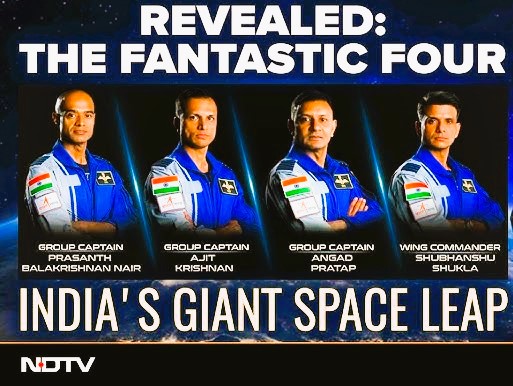
As India embarks on crewed space exploration, it joins a select group of nations capable of launching their own crewed spacecraft. This move underscores India’s growing prominence in space technology and its commitment to advancing scientific frontiers on the global stage. Looking ahead, India aims to send an astronaut to the Moon by 2040, signalling its ambitious aspirations and dedication to pushing the boundaries of human knowledge and exploration.
The unveiling of India’s first astronauts for the Gaganyaan mission marks a historic milestone in the nation’s space exploration journey. As these pioneers prepare to venture into the cosmos, they carry with them the hopes and dreams of a nation eager to explore the unknown and unlock the mysteries of the universe. With bold vision, unwavering resolve, and a spirit of collaboration, India stands poised to conquer new frontiers and inspire future generations to reach for the stars. Through its Gaganyaan mission, India reaffirms its commitment to pushing the boundaries of human knowledge and exploring the vast expanse of the cosmos.
visit arjasrikanth.in for more insights
 SOCIAL PERSPECTIVES