MS Swaminathan: The Agrarian Visionary Who Sowed Seeds of Transformation**
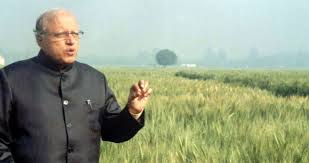
India, the land of agricultural diversity and abundance, owes much of its agricultural prosperity to the visionary leadership of Mankombu Sambasivan Swaminathan, fondly known as MS Swaminathan. As an individual fortunate enough to have had multiple encounters with him, each meeting unravelled new dimensions of agricultural development from a social perspective. His invaluable contributions, richly deserving of the Bharat Ratna, have not only transformed India’s agricultural landscape but also left an indelible mark on global food security efforts.
Swaminathan’s journey began in the backdrop of the Bengal famine of 1943, a stark reminder of the vulnerabilities faced by farmers during adverse conditions. Despite familial expectations to pursue medicine, Swaminathan’s conscience was deeply stirred by the plight of farmers, igniting his passion for agricultural sciences. His academic pursuits took him across the globe, from the University of Madras to prestigious institutions in the Netherlands and the United Kingdom, where he honed his expertise in genetics and plant breeding.
Returning to India in 1954, Swaminathan embarked on a mission to revolutionize agricultural practices. Collaborating with Nobel laureate Norman Borlaug, he spearheaded the introduction of high-yielding wheat and rice varieties, ushering in the Green Revolution in India. His efforts not only averted famine-like conditions but also catapulted India to self-sufficiency in food grains by 1971.
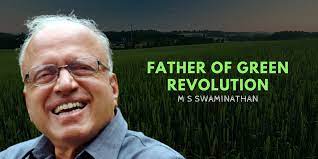
Beyond scientific research, Swaminathan’s leadership extended to institution-building and advocacy. He served as the Director-General of the Indian Council of Agricultural Research (ICAR), where he championed the integration of women and environmental concerns in agricultural policies. His tenure witnessed the formulation of landmark recommendations, including setting a minimum selling price for agricultural products, aimed at alleviating farmer distress.
Swaminathan’s influence transcended national boundaries, with Time magazine recognizing him as one of the most influential Asians of the 20th century. His advocacy for sustainable agriculture and social justice resonated globally, shaping policies to address food security challenges worldwide.
The accolades showered upon Swaminathan throughout his lifetime, including the Ramon Magsaysay Award, the World Food Prize, and the Padma Vibhushan, are a testament to his enduring legacy. However, it is the Bharat Ratna, bestowed upon him posthumously in 2024, that encapsulates the magnitude of his contributions to India’s agricultural renaissance.
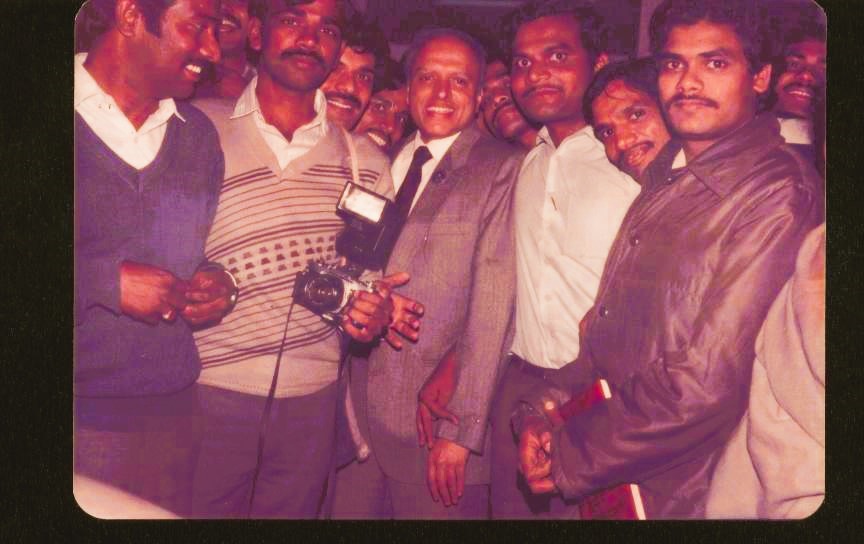
In conclusion, MS Swaminathan’s journey from the fields of India to global prominence exemplifies the transformative potential of visionary agricultural leadership. As the nation commemorates his unparalleled legacy, farmers and scientists passionately champion his vision of sustainable agriculture, securing food security for future generations. Swaminathan’s poignant words, “The future belongs to nations with grains, not guns,” stand as an enduring beacon, urging us to strive for a world where food security is not merely a privilege but an inalienable human right.
visit arjasrikanth.in / @DrArjasreekanth for more insights
 SOCIAL PERSPECTIVES