In the intricate web of Indian politics, opposition parties face a myriad of challenges as they endeavor to forge a united front against the ruling Bharatiya Janata Party (BJP). Tackling ideological divides, navigating regional complexities, and addressing internal strife arising from leadership ambitions are imperative for a cohesive opposition. The political landscape’s intricacies demand a delicate balance, requiring opposition forces to transcend individual interests and foster unity in pursuit of shared objectives. Navigating this labyrinth involves strategic maneuvers to overcome obstacles, promote collaboration, and present a formidable alternative to the incumbent regime. In the face of these challenges, the resilience of opposition parties hinges on their ability to navigate the complex political terrain and emerge as a unified force against the ruling BJP.

The INDI blog finds itself amidst a political tempest, signaling a potential tornado in the architect of the India alliance as it gears up to sever ties with Nitish Kumar. The decision, though looming, is set to be formalized soon, marking a significant blow to a party that once aspired to be the cohesive glue of the alliance. This development, coupled with setbacks in Bengal and Punjab, reveals the Congress party’s struggles as its allies, including the DMK and JD, distance themselves. The political landscape is witnessing posters being ripped in Bengal, protests in Bihar, and an overall decline in the once-promising coalition.
The Congress party, which entered Bihar with Rahul Gandhi at the helm, now faces a tumultuous situation. Nitish Kumar, along with KC Tyagi, has squarely blamed the Congress for the alliance’s failure. On the other side of the spectrum, the Congress argues that it is committed to strengthening the coalition, but the allies present a contradictory narrative. The fallout in Bengal is glaring, with Mamata Banerjee’s Trinamool Congress (TMC) showing hostility, tearing down posters, and denying entry in Siliguri. The Congress, in response, has resorted to protests and demands for action against the TMC government.
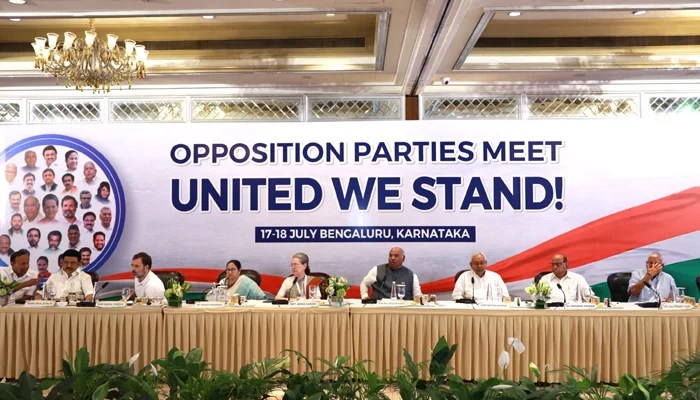
Mamata Banerjee’s solo venture in Bengal and Bhagwant Mann’s independent foray in Punjab illustrate the fractures within the opposition alliance. The TMC’s emphasis on regional autonomy and the AAP’s reservations about alliance politics introduce additional layers of complexity. In Bengal, the Congress encounters a hostile environment, while in Punjab, the AAP’s independent stance tests the cohesion of the opposition, hinting at a reconfiguration of political dynamics. These developments underscore the challenges of maintaining a united front, as regional and party-specific considerations vie with the overarching goal of countering the ruling party. The political landscape witnesses a nuanced interplay of forces, requiring opposition parties to navigate carefully to reconcile individual aspirations with the imperative of presenting a consolidated front against the incumbent regime.
The spectrum of ideologies within opposition parties, ranging from left-wing to right-wing, presents a complex mosaic that demands adept navigation. Conflicting policy positions and divergent priorities create hurdles in establishing a common ground, necessitating nuanced approaches to foster unity. This intricate challenge extends to aligning the agendas of regional parties with their national counterparts, an endeavor made complex by India’s diverse nature and robust regional identities. State-level priorities, at times, take precedence over national concerns, further complicating the formation of a cohesive, nationally aligned opposition. Overcoming these intricacies requires not just political acumen but a commitment to finding synergies that transcend ideological and regional divides, forging a united front against common adversaries.

Leadership ambitions within the opposition create internal strife, hindering the establishment of a unified leadership structure. The intense competition for prominence among parties adds to the complexity, impeding unity. In a multi-party system, the challenge intensifies as parties vie for the same voter pool, fearing the loss of their base to rivals and discouraging collaboration. Differing strategic approaches, from assertive confrontation to cautious collaboration, further complicate the landscape, impeding consensus-building and obstructing unity. Overcoming these challenges demands adept leadership navigation and strategic alignment to forge a formidable and united opposition front.
Internal divisions within the opposition arise from personal egos, historical rivalries, and animosities among political leaders. Prioritizing individual ambitions and the desire for dominance within parties often undermines collective interests and unity, presenting a significant challenge. Establishing trust and coordination among diverse opposition parties proves to be a complex undertaking. Past experiences of betrayal, a lack of trust in leadership, and differing perceptions of each other’s motives serve as persistent obstacles, impeding the creation of a cohesive and well-coordinated opposition front. Overcoming these challenges necessitates a concerted effort to address personal differences, rebuild trust, and foster a shared commitment to the broader goals of the opposition.

In conclusion, the obstacles encountered by opposition parties in India constitute a complex interplay of ideological, regional, and personal intricacies. Nevertheless, the acknowledgment of the crucial necessity for unity serves as a unifying force. Opposition parties, by confronting these challenges directly, participating in constructive dialogues, and striving towards a shared objective, possess the capacity to successfully navigate the intricate political labyrinth. A consolidated and formidable front against the ruling party is not merely a political aspiration but an indispensable requirement for a flourishing and dynamic democratic landscape. The unfolding developments in the INDIA bloc underscore the pressing need and multiple problems for opposition parties to solidify a united front, recognizing that their collective strength is the linchpin for navigating the intricate political landscape of India, which is a mammoth task in days ahead.
visit arjasrikanth.in for more insights
 SOCIAL PERSPECTIVES
One response to “INDIA-Bloc: Navigating the Political Labyrinth: Challenges and Alliances in India’s Complex Political Landscape”
Well Covered
LikeLike