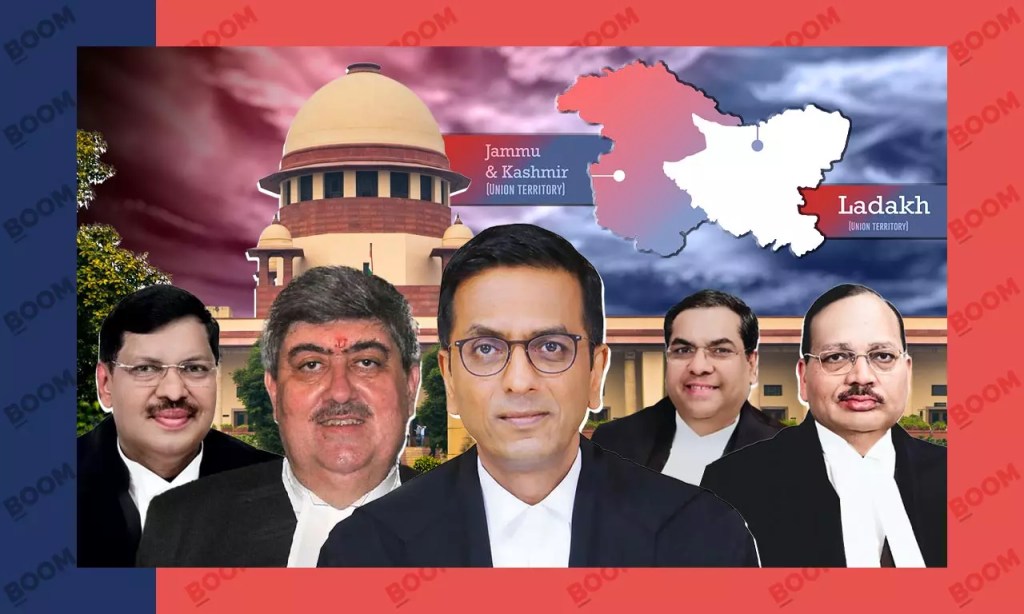
“Shifting Tides – The Supreme Court’s Ruling on Article 370 Reshapes India’s Federal Landscape”
The recent landmark judgment by the Supreme Court of India, upholding the abrogation of Jammu and Kashmir’s special status under Article 370, signifies more than just judicial deference. It marks a departure from the Court’s established positions on federalism, democratic norms, and the sanctity of legal processes. This article delves into the nuances of the judgment, its political implications, and the constitutional intricacies that shape the future of J&K and, potentially, other states in India.
The Supreme Court’s decision is undoubtedly a political triumph for the ruling Bharatiya Janata Party (BJP), offering a legal imprimatur to its audacious move in August 2019. By stripping Kashmir of its special status and bringing it in line with other states, the government secured a significant victory. However, the judgment also sparks debates about the subversion of federal principles, a lack of historical context appreciation, and potential repercussions for constitutional procedures.
A significant concern emanates from the Court’s assertion that Parliament, during President’s Rule, can enact any legislation, even with irreversible consequences, on behalf of the State legislature. This interpretation challenges a fundamental feature of the Constitution, paving the way for a range of hostile and irrevocable actions without the involvement of an elected body. The potential implications for the rights of states are grave, as it allows for unilateral actions in the absence of a representative government.
The government’s intricate process to remove J&K’s special status involved a Constitutional Order on August 5, 2019, applying the entire Constitution to the region. Despite certain aspects being deemed unconstitutional, the consequential notification on August 6, declaring Article 370 as valid, was upheld. The Court’s rationale that the Constitution of India has been applied incrementally over the years raises questions about historical obligations and promises made to J&K.
The Court’s conspicuous silence on whether the Constitution permits the reorganization of J&K into two Union Territories leaves a critical question unanswered. By choosing not to adjudicate on the first-ever use of Article 3 of the Constitution to downgrade a state, the Court’s decision raises concerns about judicial evasion. The assurance of restoring J&K’s statehood, while accepted by the Court, invites scepticism about the validity of such assurances as legal safeguards.
The ruling, while upholding Indian sovereignty over J&K, sets a precedent that tilts the scales in favour of the Union. The Court’s position that there are no limits on the President’s power or Parliament’s competence to act on behalf of the State government and its legislature poses a substantial threat to the powers devolved to the states. The potential misuse of “non-legislative” powers by state assemblies under President’s Rule introduces a perilous dimension to the federal structure.
The Supreme Court’s verdict on Article 370 represents a turning point in India’s constitutional trajectory. While the decision settles the specific case, it also raises critical questions about the distribution of powers, federalism, and democratic processes. As the nation grapples with the implications of this judgment, it becomes imperative to navigate the constitutional waters carefully, ensuring a delicate balance between the union and the states in the world’s largest democracy. The constitutional tapestry has been unraveled, and the course ahead demands a careful reweaving of the fabric that binds the diverse states of the Indian republic.
Disclaimer: Personal Views stand corrected.
visit arjasrikanth.in for more insights
 SOCIAL PERSPECTIVES