“India’s Millet Triumph: Codex Alimentarius Commission Lauds Global Standards Proposal”
“FSSAI’s Kamal Vardhan Rao Leads India’s Charge at Codex Alimentarius, Ushers in Millet Recognition”
In a ground breaking achievement, India’s relentless pursuit of elevating millets to global acclaim has found resounding acknowledgment at the 46th session of the Codex Alimentarius Commission (CAC) held in Rome, Italy. The commission, a globally revered standard-setting body for food safety and quality, showered praise on India’s Standards on Millets and endorsed the nation’s proposal for the development of global standards for millets. Led by CEO, FSSAI, Shri G Kamala Vardhana Rao, the Indian delegation’s strategic move aligns perfectly with the celebration of 2023 as the International Year of Millets.
India has meticulously crafted a comprehensive group standard for 15 varieties of millets, outlining eight critical quality parameters. This initiative has been hailed at the international meet where Codex currently holds standards for Sorghum and Pearl Millet. India’s forward-looking proposal for global standards particularly spotlights Finger millet, Barnyard millet, Kodo millet, Proso millet, and Little millet as group standards – akin to those established for pulses.
Union Minister of Health & Family Welfare, Dr. Mansukh Mandaviya, extended heartfelt congratulations to the Indian delegation during this momentous occasion. Dr. Mandaviya emphasized that India’s instrumental role has made millets the preferred choice for people worldwide. He envisions India’s proposal as a benchmark that will illuminate the inherent benefits of millets on a global stage.
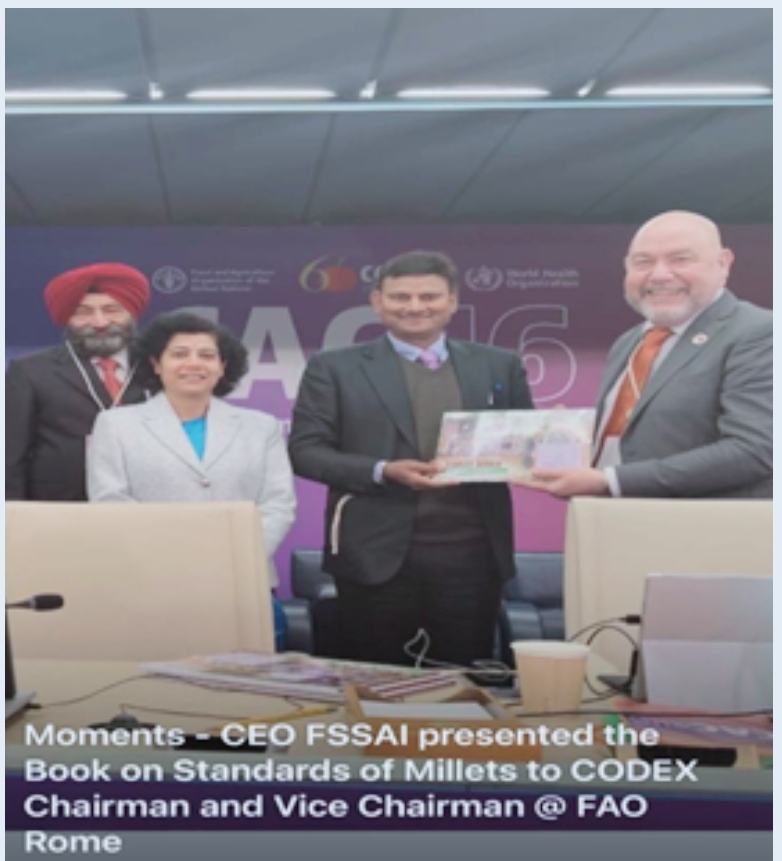
The CEO of FSSAI, Shri G Kamala Vardhana Rao, leading the Indian delegation, presented the book on Standards of Millets to CODEX Chairman, Mr. Steve Wearne. The proposal aligns not only with the declaration of 2023 as the “International Year of Millets” but also resonates with the escalating international trade in millet-based products. The Codex Alimentarius Commission’s endorsement now propels India to initiate the development of draft standards based on the submitted project documents.
The group standards proposed by FSSAI for 15 types of millets lay the groundwork for defining essential quality parameters. These include maximum limits for moisture content, uric acid content, extraneous matter, other edible grains, defects, weevilled grains, and immature and shrivelled grains. This framework is poised to act as a cornerstone for the creation of global standards. Notably, existing Codex standards for Sorghum and Pearl millet would also be revisited during the formulation of group standards for millets.
The 46th session of the Codex Alimentarius Commission commemorates the 60th anniversary of the esteemed body, of which India has been a proud member since 1964. India’s active role in chairing and co-chairing numerous Expert Working Groups (EWGs) relating to various Codex standards/texts and guidelines reflects the nation’s commitment to international food safety standards. Among the crucial standards proposed by India are those for Okra, BWG Pepper, Aubergines, Dried and Dehydrated Garlic, Dried or Dehydrated Chilli Pepper and Paprika, Fresh Dates, Mango Chutney, Chili Sauce, Ware Potatoes, and labeling requirements for non-retail containers.
India’s remarkable success at the Codex Alimentarius Commission not only propels millets to unprecedented global recognition but solidifies the nation’s role as a pioneer in setting international food safety and quality standards. The visionary leadership of Union Minister Dr. Mansukh Mandaviya and the strategic functioning of CEO Kamala Vardhana Rao played a pivotal role in orchestrating this triumph. Their dedication to steering India’s millet odyssey showcases a paradigm of proactive engagement resonating globally. The comprehensive group standard for 15 millet types, presented by CEO Kamala Vardhana Rao, defines eight quality parameters, setting the groundwork for future global standards. India’s commitment to nutritious, sustainable, and globally embraced food choices, particularly during the International Year of Millets, reinforces its leadership in shaping the discourse around food safety and quality. This triumph signifies a broader commitment to holistic well-being and environmental sustainability, making India’s millet movement a global exemplar.
Visit arjasrikanth.in for more insights
 SOCIAL PERSPECTIVES