“In the shadow of advanced technology, the inhumane practice of manual scavenging persists, claiming lives and dignity. This is a battle for freedom, equality, and humanity.”
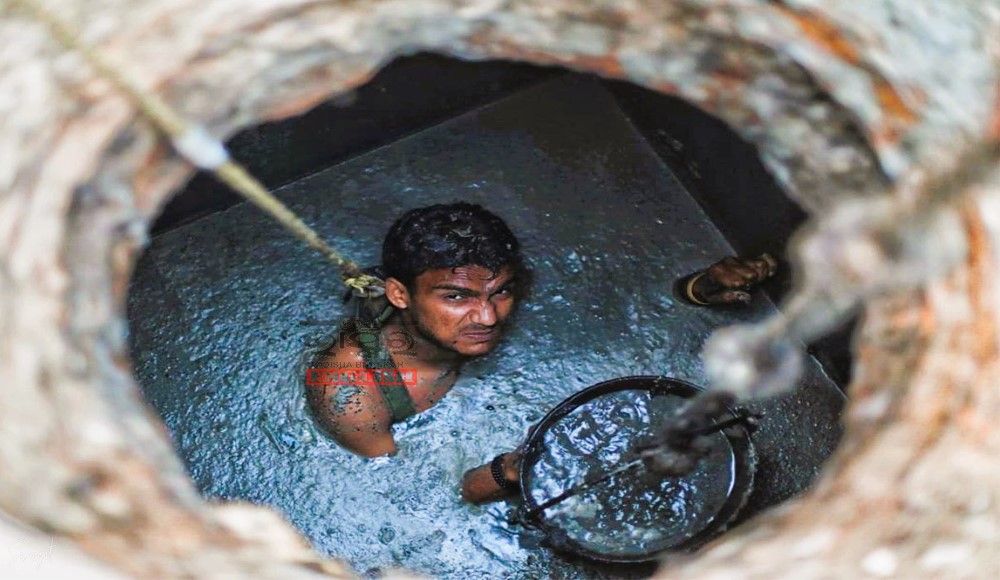
In an age where technology and innovation have ushered in remarkable advancements, it is a stark paradox that the practice of manual scavenging still exists in parts of our country. The individuals engaged in this perilous task are often those living below the poverty line, driven by desperation to make ends meet. They risk their lives on a daily basis, wading through hazardous sewage and drain networks, encountering poisonous water and dangerous situations that no one should ever have to face.
The conditions in which these individuals live and work are nothing short of deplorable. Over the past year, over 350 deaths have been reported, with a significant number of them occurring in regions such as Uttar Pradesh and Delhi. Manual scavenging, in this day and age, is not just an unfortunate reality; it is an egregious violation of human rights and a blot on our society.
The Supreme Court’s recent directive has brought the issue to the forefront once again, highlighting the urgent need to completely eradicate manual scavenging. It’s a battle for freedom, a battle to reclaim human dignity, and a battle for the fundamental rights that every citizen of this nation should enjoy.
The recent verdict by the Supreme Court, delivered by Justice S. Ravindra Bhat and Justice Aravind Kumar, in response to a Public Interest Litigation (PIL) filed by social activist Balram Singh, is a resounding call to end the practice of manual scavenging. The court, in no uncertain terms, has emphasized the need for complete eradication of this inhumane practice.
The court has not only recognized the gravity of the situation but has also significantly enhanced the compensation provided in cases of sewer deaths and injuries. It has decreed that those who suffer permanent disabilities while cleaning sewers should receive a minimum compensation of ₹20 lakh, and for other injuries, a compensation of up to ₹10 lakh can be paid to the victims. In cases of fatalities, the court has directed the Centre and state governments to pay ₹30 lakh as compensation to the next of kin.
The Supreme Court’s verdict is not just about monetary compensation; it is a clarion call for freedom and dignity. It resonates with the words of Dr. B.R. Ambedkar, one of the architects of the Indian Constitution, who spoke about the battle for freedom and the reclamation of human personality.
In his judgment, Justice S. Ravindra Bhat quoted Dr. Ambedkar, reminding us that the battle against manual scavenging is not a battle for wealth or power; it is a battle for the very essence of freedom and human rights. This battle is a reflection of our commitment to creating a just and equal society, where every citizen can live with dignity and without fear.
The court’s directive not only seeks to provide financial compensation but also underscores the need for rehabilitation and support for the victims and their families. It calls for the provision of scholarships and skill development training for the kin of the victims, acknowledging that economic and social rehabilitation is an integral part of ending the cycle of manual scavenging.
The bench has rightly emphasized that the duty to eradicate manual scavenging is not the sole responsibility of the government but a collective duty imposed on every citizen. The Constitution, through its emancipatory provisions, calls upon each one of us to uphold the promise of equality and dignity. The Union and state governments are bound by this duty to ensure the complete eradication of manual scavenging, not just in letter but also in spirit.
The plight of manual scavengers, who have remained unseen, unheard, and systematically trapped in inhuman conditions, demands our immediate attention and action. The Constitution and the provisions of the 2013 Act expressly prohibit this practice, and it is incumbent upon the government and society to implement these provisions to the fullest. Justice Bhat underscores the value of dignity and fraternity, stating that without these, all other liberties are meaningless. It is a wake-up call to all citizens, urging them to confront the darkness that has plagued generations of our people and dispel it once and for all.
The Supreme Court has issued 14 critical directives to the Union and state governments to ensure the effective implementation of the Prohibition of Employment as Manual Scavengers and their Rehabilitation Act, 2013. These directives are designed to not only put an end to manual scavenging but also to provide comprehensive support to the victims.
Among the directives is the call for government agencies to coordinate and ensure that incidents of sewer deaths do not occur. High courts are not precluded from monitoring cases related to sewer deaths, signaling a commitment to oversight and accountability.
Furthermore, the court’s judgment reaffirms the need for the Union and state governments to work together to eliminate manual scavenging. The statistics are grim, with at least 347 people losing their lives while cleaning sewers and septic tanks in India over the past five years. Uttar Pradesh, Tamil Nadu, and Delhi alone accounted for 40% of these deaths. It is a stark reminder that the battle against manual scavenging is far from over.
In conclusion, the battle against manual scavenging is not just a legal battle; it is a moral and humanitarian imperative. The Supreme Court’s verdict is a step in the right direction, but it is not the end of the road. It is a call to action for every citizen, every government, and every institution to take collective responsibility for the complete eradication of this inhumane practice.
As we continue this battle for freedom, dignity, and equality, let us remember that it is our duty to ensure that no one is forced into the darkness of sewers for a living, and no one loses their life in such deplorable conditions. This battle is about realizing true fraternity, about upholding the values of our Constitution, and about ensuring that every citizen can proudly bask in the achievements of our republic without the shadow of manual scavenging looming over them.
The battle for dignity and freedom continues, and with it, the hope for a brighter, more equal, and more humane future. It’s a battle we must fight together, and it’s a battle we must win.
visit arjasrikanth.in for more insights.
 SOCIAL PERSPECTIVES