Introduction
Title: Navigating the Cauvery Waters: Resolving India’s Oldest River Dispute
Introduction
The Cauvery River, often referred to as the “Ganges of the South,” flows through several Indian states, including Karnataka, Tamil Nadu, Kerala, and the Union Territory of Puducherry. This majestic river, with its origins in Karnataka, is a vital source of water for irrigation, agriculture, and daily life in these regions. However, the distribution of Cauvery River water has been at the heart of one of India’s longest-standing and most contentious water disputes.
The Cauvery Water Dispute has its roots in historical agreements, differing demands, and fluctuating rainfall patterns. This dispute, which began during the colonial era, has persisted for over a century, leading to tensions and conflicts between Karnataka and Tamil Nadu. In this article, would delve into the history of the Cauvery Water Dispute, the role of various authorities, and the recent developments in this ongoing conflict.
The Cauvery Water Dispute can be traced back to the late 19th century when the British government presided over agreements to allocate the river’s waters among the princely states of Mysore and Madras Presidency (now Karnataka and Tamil Nadu, respectively). Two pivotal agreements, the 1892 and 1924 agreements, laid the foundation for the dispute that would continue for generations.
The 1892 Agreement: This initial agreement, between the State of Mysore and Madras, primarily focused on new irrigation works across the Cauvery River.
The 1924 Agreement: In 1910, both Mysore and Madras proposed irrigation projects on the Cauvery. When disagreements arose, the British government intervened and appointed a Court of Arbitration led by Sir Henry Griffin. Under Griffin’s guidance, an agreement was reached in 1924, designed to remain in effect for 50 years.The 1924 agreement stipulated that, for five decades, Tamil Nadu and Puducherry would receive 75 percent of the Cauvery water allocation, while 23 percent would be allocated to Mysore (now Karnataka), with the remaining flowing into Kerala. This agreement laid the groundwork for the distribution of Cauvery River water.
The Cauvery Water Dispute persisted even after India gained independence and underwent state reorganization in 1956. The issue escalated as Tamil Nadu expanded its irrigated areas and Karnataka constructed dams on the river in response to a growing demand for water.
In 1990, the Indian government constituted the Cauvery Water Disputes Tribunal (CWDT) to adjudicate the water sharing issue. After years of deliberation, the CWDT issued its final order in 2007, which allocated Cauvery water among the concerned states as follows:
- Tamil Nadu: 419 TMC (thousand million cubic feet)
- Karnataka: 270 TMC
- Kerala: 30 TMC
- Puducherry: 7 TMC
However, even after this allocation, the dispute did not come to an end. Karnataka and Tamil Nadu continued to grapple over the sharing of water, especially in years with inadequate rainfall. The lack of a clear formula for sharing water during these deficit years exacerbated the conflict.
The Cauvery Water Dispute reached the Supreme Court of India once again in 2018, resulting in a decrease in Karnataka’s annual water releases from 192 TMC to 177.25 TMC. Tamil Nadu’s share of water was also reduced. This decision by the Supreme Court aimed to balance the interests of both states.
On June 1, 2018, the Indian government established the Cauvery Water Management Authority (CWMA) to oversee the implementation of the court’s judgment. The CWMA comprises the Prime Minister as Chairperson and the Chief Ministers of the basin states as members, with the Secretary of the Ministry of Water Resources serving as its Secretary.
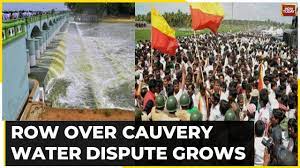
In September 2023, the dispute once again made headlines as the Supreme Court ordered Karnataka to release 5,000 cubic feet per second (cusecs) of Cauvery water to Tamil Nadu. This decision was met with resistance from various farmers’ groups and pro-Kannada activists, who called for a strike.
Tamil Nadu, in response, approached the Supreme Court, requesting that Karnataka release 7,200 cusecs of water per day from its reservoirs. The Court was asked to instruct Karnataka to adhere to the release of 36.76 TMC of water for September 2023, as mandated by the CWDT’s final award.
The Cauvery Water Dispute reflects the complexities of sharing water resources in a country as diverse as India. Collaborative solutions are crucial for equitable water management and conflict resolution. While the recent Supreme Court orders aim to strike a balance, they also highlight the importance of addressing the needs of both upstream and downstream states.
In years of abundance, there is little difficulty in Karnataka releasing water in compliance with the final award of the CWDT. However, during deficit years, the parties involved need a regular formula to share the shortfall and distress equitably.
The CWMA and the Cauvery Water Regulation Committee (CWRC) must gather and analyze data on rainfall, inflows, and storage to develop an acceptable formula for apportioning the shortfall. It is essential for both states to set aside political considerations and allow domain expertise to guide the resolution process.
The Cauvery Water Dispute is a complex and long-standing issue that has tested the resilience of India’s federal structure and legal system. The river’s importance to the states it traverses cannot be overstated, and equitable water sharing is crucial for the well-being of millions of people.Recent Supreme Court orders demonstrate the need for a more permanent and collaborative solution to address the recurring disputes. The CWMA and CWRC have a vital role to play in developing a formula that respects the rights of both upstream and downstream states during periods of scarcity and abundance. Ultimately, resolving the Cauvery Water Dispute requires a commitment to dialogue, data-driven decision-making, and a shared vision for sustainable water management in the region. The river that flows through many states should serve as a source of unity and prosperity, rather than a point of contention and conflict.
arjasrikanth.in
 SOCIAL PERSPECTIVES